
“The body is no longer merely a place of pleasure or sin; it has become a quantifiable datum, an optimized flow monetized on the markets of attention.”
Sociology of Market Connections
Introduction
In contemporary times, digital technology and globalized capitalist logic complete the mutation of desire into a mere commodity. This eleventh and final chapter examines the hypermodern era, where dating apps, industrialized pornography, and connected solitude reduce the intimate bond to an algorithmic transaction, sealing the long historical cycle of the dispossession of the flesh.
Synthesis Part: The Modern Heritage : Between Ancestral Guilt, Commodification, and the Quest for Re-enchantment
“Man is born free, and everywhere he is in chains.
One thinks himself the master of others, and still remains a greater slave than they.”
— Jean-Jacques Rousseau, The Social Contract (1762)
1. The Engineering of Control: Millennial Manipulation
At the end of this historical journey, one observation stands out with anatomical clarity: the domestication of human sexuality stems from no immutable natural or biological order. It is the product of social and dogmatic engineering orchestrated over several millennia.
The contemporary human being unknowingly inherits deep conditioning. The great ancestral manipulation consisted of isolating the vital force, the most powerful, creative, and intimate energy of the individual, to transform it into a lever of subjugation:
The Splitting of the Being: By separating the flesh from the spirit and declaring the former inferior and corrupting, systems of power created an internal fracture within the individual.
The Monopoly of Salvation: By convincing humans that their natural desire constitutes an ontological fault, ecclesiastical and political institutions set themselves up as indispensable intermediaries, the sole entities capable of forgiving, purifying, and ordering the city.
2. The Secularization of the Norm: From Sin to Pathology
While religious power waned over the course of modernity, the machinery of control never disappeared; it simply changed its mask and vocabulary. Beginning in the 19th century, psychiatry, medicine, and biopolitics (as analyzed by Michel Foucault) took over from dogma:
From Priest to Physician: The notion of « sin » was progressively replaced by that of « deviance, » « abnormal obsession, » or « perversion. » The body was no longer confessed in the temple, but ausculted, cataloged, and classified in the hospital.
Bourgeois Normativity: Sexuality remained strictly channeled to serve economic productivity, family order, and the reproduction of labor power, maintaining prohibition and the sense of shame under scientific guises.
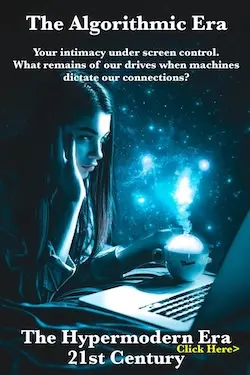
3. Mass Pornography and the Digital Panopticon: The False Liberation
The 20th and 21st centuries claimed to orchestrate the « sexual revolution. » Yet far from a return to the immanent sacredness of origins, this apparent liberation morphed into a new form of alienation: the complete commodification of the flesh.
[Saturated screens, advertising hyper-sexualization, algorithmic flows, and the commodification of desire]
The Disenchantment of Desire: Desacralized and emptied of its potential for spiritual metamorphosis or philosophical elevation, the body became a routine consumer good. Industrial pornography and social networks transformed the erotic mystery into a mechanical, algorithmic, and addictive spectacle.
The Injunction to Perform: The old guilt of « sin » was succeeded by a new anxiety: that of performance, aesthetic conformity, and permanent availability. The flesh is no longer condemned; it is consumed to exhaustion.


4. Re-enchantment: Recovering the Original Vital Force
Faced with this dual impasse, ancestral guilt on one hand, empty commodification on the other, the reconquest of the self requires an act of lucid and sovereign reappropriation:
Dismantling the Memory of Dogma: Becoming aware that shame, anxious restraint, and the body/mind duality are not givens of human consciousness, but dated historical constructions.
Reclaiming the Sanctuary of the Body: Reconnecting with the primary intuition of ancient civilizations: the body is neither a prison of the soul nor a consumer object. It is the receptacle of vital force, the site of presence, disinterested pleasure, and recovered sovereignty.
Pourquoi aimons-nous lire des histoires érotiques intenses ?
Parce qu'elles permettent de vivre des émotions fortes en toute liberté, loin des règles du quotidien.