
“Let him serve the state, let him guide his conduct by the customs of the ancestors, and let him reserve the mastery of his body for the safeguarding of his honor.”
— Cicero, De Officiis (c. 44 BCE)
Introduction
In the Roman Empire, sexuality was inseparable from political order, citizenship, and the perpetuation of patria potestas. This fifth chapter examines how the Republic and subsequently the Empire regulated bodies under the dual seal of virilitas and pudicitia, transforming carnal practice into an instrument of social hierarchy, civic control, and institutional domination.
Single Part: Ancient Rome
1. Roman Pragmatism: Sexuality at the Service of Social Status
While Classical Greece intellectualized the body through the lens of philosophy, Rome approached it from a strictly political, legal, and social angle. In ancient Rome, sexuality was neither a path of spiritual awakening nor a matter of moral shame. It was a marker of power, hierarchy, and citizenship.
The Absence of a Hetero/Homosexual Binary: Romans did not conceive sexuality in terms of orientation (heterosexuality or homosexuality), but in terms of an active or passive polarity.
Active (Penetrans) versus Passive (Penetratus): For a Roman citizen (vir), being the active agent in the sexual act was an affirmation of his domination, authority (auctoritas), and virility. Conversely, accepting a passive role meant surrendering one’s sovereignty and risking civic degradation.

2. Pudicitia and the Law: The Familial Matrix and Social Conservatism
At the heart of Roman society reigned the concept of Pudicitia (modesty, restraint, corporal virtue), which applied differently depending on gender and social rank.
The Paterfamilias and the Matron: The father of the family held absolute power (patria potestas) over his household. The Roman matron (matrona), wife of the citizen, was expected to embody reserve, chastity toward third parties, and fidelity. Her sexuality was strictly channeled to guarantee the legitimacy of heirs and the purity of patrician lineages.
The Realm of Available Bodies: To satisfy desire outside marriage, Roman society placed at the citizen’s disposal an entire category of bodies devoid of protective legal status: slaves (servi), freedmen, prostitutes (meretrices), and actors. Penetrating these bodies compromised neither the citizen’s morality nor his honor, as these individuals were perceived as property or beings outside civic law.
3. The Erotic Art of Pompeii and Phallic Fascination
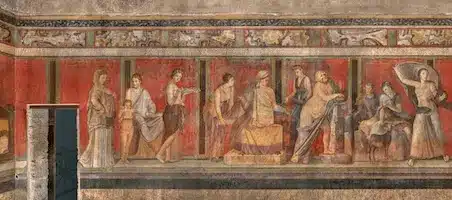
The archaeology of Campanian cities (Pompeii, Herculaneum) reveals an uninhibited, daily, and omnipresent relationship with erotic imagery and the phallic symbol.
The Fascinus as an Apotropaic Talisman: The phallus carved onto house walls, worn as an amulet around children’s necks, or depicted at crossroads held no pornographic function. It was the Fascinus, a sacred symbol designed to ward off the evil eye (invidia), attract good fortune, and protect the city.
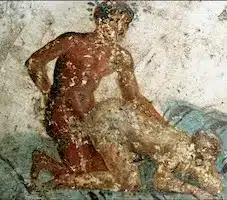
Lupanars and Wall Painting: Frescoes from the Villa of the Mysteries or the Lupanar of Pompeii show explicit erotic scenes. They functioned both as service catalogs in brothels and as ornaments celebrating the joy of living, Dionysus/Bacchus, and the power of nature in aristocratic residences.
4. Imperial Stoicism: Seneca, Epictetus, and Marcus Aurelius
Under the Empire, the Roman elite progressively adopted Stoicism as a philosophy of life, emphasizing self-control and sobriety in the face of carnal temptations.
Seneca and the Condemnation of Excess: In his Letters to Lucilius, Seneca condemned debauchery, not in the name of a vengeful God, but because enslavement to the senses destroyed the sage’s inner freedom and capacity to govern.
Marcus Aurelius and Demystifying Pleasure: In his Meditations, the philosopher-emperor applied a materialist and lucid analysis to demystify desire: the sexual act was reduced to « the friction of a piece of gut and the ejaculation of a little mucus. » This detachment laid the mental groundwork for a complete desacralization of the flesh.
Pourquoi aimons-nous lire des histoires érotiques intenses ?
Parce qu'elles permettent de vivre des émotions fortes en toute liberté, loin des règles du quotidien.