
“The human soul has seen truth before being incarnated into this tomb we call the body.”
Plato, Phaedrus
Introduction
From the power of Eros as a primitive force uniting original chaos to the philosophical formulations of the Classical era, Ancient Greece underwent a decisive mutation. This fourth chapter analyzes the transition from a sexuality tied to civic cults and mythological vitality toward Platonic dualism, which began separating pure intellect from the prison of carnal matter.
Part 1: Archaic Greece — Cosmic Eros and the Celebrated Body
“First of all came Chasm (Chaos);
then broad-bosomed Earth (Gaia)
and Eros, who is the most beautiful among the immortal gods,
who unstrings the limbs and in the breasts of all gods and all men
subdues reason and wise counsel.”
Hesiod, Theogony (ll. 116–122, c. 8th century BCE)
1. Primordial Eros: Cosmogononic Force and Dynamics of Union
In Archaic Greece, long before the metaphysical formulations of Classical philosophy, Eros was not the winged boy with arrows (Cupid) of the Hellenistic period. He was an irrepressible elemental power, one of the primary deities emerging immediately after Chaos.
The Engine of Creation: In Hesiod, Eros is the principle of universal attraction without which no union is possible. This is not merely individual romantic attraction, but the cosmogonic gravitational force prompting separated elements to assemble and give birth to the order of the world (Cosmos).
A Taming Force (Dameris): Archaic eroticism was experienced as a divine invasion (atē or mania). One seized by Eros felt their knees weaken and their reason falter. A distant precursor to sin, this faltering was nevertheless no fault: it was proof of humanity’s submission to the fundamental laws of nature and the power of the gods.
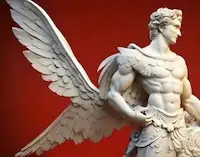
2. The Celebration of the Body (Kalokagathia) and Athletic Nudity
Archaic Greece radically distinguished Hellenic culture from neighboring civilizations through the place accorded to public nudity and the aesthetics of the body.
Ritual Nudity (Gymnos): During Panhellenic games (Olympic, Isthmian, Nemean), athletes competed entirely naked (gymnos), their bodies anointed with olive oil. This nudity held no shame; it was the mark of the free man as opposed to the barbarian.
Kalokagathia (Kalokagathia): A key concept uniting the beautiful (kalos) and the good (agathos). The physical beauty of a body sculpted by effort was no simple aesthetic asset: it directly reflected the noble worth of the soul (arēte) and divine favor.
Statues of Men and Women (Kouroi and Korai): Archaic sculpture erected representations of youths with defined musculature and enigmatic smiles. These statues were not profane portraits: they were consecrated in sanctuaries as perfect offerings to the gods, pairing the eroticism of youth with the sacred.
3. Sappho of Lesbos and the Eroticism of Female Desire
In the 6th century BCE, the island of Lesbos became the cradle of lyric poetry of unmatched freedom and intensity, spearheaded by the poetess Sappho.
The Pantheon of Aphrodite: In the thiasoi (religious and educational communities for young women), Sappho invoked the goddess Aphrodite not as a distant judge, but as an intimate ally. Physical love and passionate attraction between women were celebrated as a path of aesthetic and spiritual elevation.
The Phenomenology of Desire: Sappho’s famous Fragment 31 describes with unparalleled precision the somatic impact of eroticism: the broken voice, the subtle fire under the skin, the ringing ears, and the trembling of the entire body. Carnal experience served as the space where mortals touched divine intensity.


4. Initiatory Pederasty: Education and Transmission
In the Archaic polis (notably in Sparta, Crete, or Thebes), the erotic relationship between an adult man (Erastes, the desirer) and a young man (Eromenos, the desired) constituted a codified social and educational institution.
A Rite of Passage: Far from being reduced to a purely genital act, paiderastia was a relationship of civic, military, and moral initiation. The Erastes imparted to the Eromenos his knowledge, courage (arēte), and responsibility as a future citizen.
Ethical Codification: Desire had to be accompanied by restraint and respect for dignity. The young man’s beauty stimulated military emulation and the elder’s quest for glory (kleos).
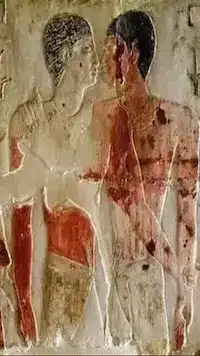
5. The Absence of Carnal Guilt
In Archaic Greece:
The flesh was in no way a site of original defilement.
Sexual attraction, sensual pleasure, and the contemplation of beauty were acts of homage paid to Aphrodite, Eros, and Dionysus.
The only condemned excess was hybris (hubris: the pride leading a human to consider themselves equal to the gods or to violate laws of hospitality and justice), not the feeling of desire or the expression of vital body power.
Part 2: Classical Greece — The Platonic Fracture and Dualism
“For the body provides us with a thousand troubles because of its necessary maintenance […]
It fills us with loves, desires, fears, all sorts of fancies and endless foolishness,
so that in truth, as the saying goes, it really takes away from us all power of thinking at all.”
Plato, Phaedo (66b–c, c. 4th century BCE)
1. The Philosophical Shift: From Physiology to Suspicion of Matter
With the Athenian Classical Age (4th century BCE), a decisive intellectual mutation occurred. While Archaic centuries celebrated the immanent harmony of flesh and cosmos, Socratic and Platonic philosophy introduced a major conceptual fracture: the ontological separation between the body (Sōma) and the soul (Psychē).
The Body as a Tomb (Sōma / Sēma): Inspired by Orphic and Pythagorean currents, this Platonic phrasing marked a fundamental shift. The physical body was no longer perceived as the glorious vessel of vital force, but as a prison, an obstacle, or an obscure veil clouding the vision of Intelligible Truths.
The Tyranny of Appetites: Physiological needs, pain, and especially frenetic sexual desire were henceforth analyzed as anarchic disruptions enslaving the superior, rational part of the soul (Logistikon).
2. The Sublimation of Eros: The Symposium and the Ladder of Love
In The Symposium, Plato did not categorically reject Eros, but performed a radical reinterpretation of its function. He formulated the concept of Eros as a mediator and a philosophy of elevation:
Decoupling from the Flesh: Physical attraction to a beautiful body constituted the first step, the starting point of erotic impetus. However, for Plato, stopping at bodily enjoyment was a spiritual regression. The sage had to use carnal desire as a springboard to ascend gradually toward the beauty of souls, virtues, and knowledge, culminating in the contemplation of the pure Idea of Beauty.
The Emergence of « Platonic Love »: Carnal union thus lost its intrinsic sacred value. It was tolerated only to the extent that it triggered a metaphysical quest that ultimately transcended and abandoned it.
3. Aristotle and Biological Order: The Functionalization of the Body
If Plato devaluation of the body favored the Ideas, Aristotle adopted a naturalistic and teleological approach (focused on purpose or end) that likewise redefined the relationship to sex:
The Body as an Instrument of Form: In De Anima and On the Generation of Animals, the body is matter (Hylē) structured by soul (Morphē). Sexuality was reintroduced into the realm of nature, but strictly functionalized.
Procreative Purpose: The sexual act derived its essential legitimacy from the continuation of the species and the city. Sensual pleasure was no longer a sacred end in itself nor a means of communion with the divine: it became a simple biological stimulant granted by nature to ensure reproduction.
4. Stoic Autarky: Mastery of Passions (Apatheia)
Toward the end of the Classical period and the beginning of the Hellenistic era, the Stoic school (founded by Zeno of Citium) deepened the demand for self-control.
Passion as a Sickness of the Soul: For the Stoics, uncontrolled erotic desire (Eros) was a passion (Pathos), a flawed judgment and a loss of inner sovereignty.
Self-Governance: The sage was required to cultivate composure, emotional tranquility (Ataraxia), and freedom from destructive passions (Apatheia). Sexuality had to be subjected to reason (Logos), stripped of its ecstatic, theatrical, and passionate nature.
5. Assessment of the Greek Mutation
By the end of this philosophical evolution, the Greek world laid the mental groundwork—without yet formalizing it dogmatically for a future civilizational shift:
The body was decoupled from the mind.
Physical desire was no longer a cosmic divine force, but an animal drive requiring control, direction, or sublimation.
A line was drawn between material flesh (inferior, vulnerable, deceptive) and timeless spirit (noble, pure, divine).
Pourquoi aimons-nous lire des histoires érotiques intenses ?
Parce qu'elles permettent de vivre des émotions fortes en toute liberté, loin des règles du quotidien.