
,“Pleasure, when mastered by the science of breath, is no longer a mere dissipation, but the vehicle of immortality.”
— Classical Treatises of Eastern Erotology
Introduction
Far from mere hedonistic pursuit or simple procreation, the traditions of Vedic and Tantric India as well as Taoist China developed a subtle science of sexual energy. This third chapter examines how the treatises of the Kama Sutra and the Taoist bedchamber arts (Fangzhongshu) envisioned carnal union as an inner alchemy, enabling the transmutation of bodily fluids and the union of the cosmic polarities of Yin and Yang.
Part 1: Vedic and Tantric India — Energy, Śakti, and the Transmutation of Desire
“Desire arose in the beginning,
which was the primal seed and germ of spirit.”
— Rig-Veda (Hymn X, 129)
1. Kama: The Third Goal of Existence
In the Vedic and Brahmanical thought of ancient India, human existence did not revolve around a dualism of good and evil, but was organized according to the Purusharthas—the four legitimate aims of life:
Dharma: Moral duty, ethical and cosmic order.
Artha: Material success, prosperity, and power.
Kama: Sensual pleasure, eroticism, love, and aesthetic enjoyment.
Moksha: Spiritual liberation from the cycle of rebirth (Samsara).
Far from being perceived as an obstacle to spiritual realization, Kama was recognized as a fundamental pillar of human balance. Without desire, there is neither movement, creation, nor aspiration toward liberation. Eroticism was not merely tolerated by default: it was codified, celebrated, and integrated as a sacred science.
2. The Kamasutra: A Metaphysics of Eroticism
Composed around the 3rd century CE by the sage Vatsyayana, the Kamasutra is frequently reduced in modern Western culture to a manual of acrobatic positions. In reality, this text belongs to a rigorous academic and philosophical tradition.
A Comprehensive Education: The text addresses educated men and women (Nagaraka). It advocates the learning of 64 major arts (Kalas), ranging from music and poetry to perfumery, massage, chess, and the mastery of caresses.
Equality of Pleasure: Contrary to later patriarchal views, the Kamasutra places central importance on female pleasure, explicitly stating that union is unfulfilled unless the woman achieves orgasm and emotional fulfillment.
Sacralization of Detail: The embrace, the gaze, the voice, and fragrances are perceived as vehicles for refining human consciousness.
3. Shiva and Śakti: The Primordial Polarity
At the core of Tantric metaphysics, the cosmos rests upon the continuous interaction of two inseparable principles:
Shiva: Pure, unmoving, silent, and transcendent consciousness. He represents the masculine principle, yet remains inert without the energy to set him in motion.
Śakti: Dynamic energy, creative matter, generative power, and immanent manifestation. She represents the feminine principle, the Great Goddess through whom the world takes form.
Without Śakti, Shiva is referred to in Tantric texts as a Shava (a corpse). The entire universe is the product of the erotic and cosmological play (Lila) between consciousness and energy. Human sexual union is the exact micro-cosmic replication of this primordial cosmic dance.
4. Tantrism: Transmuting Desire into Awakening
While other ascetic paths advocated renunciation, rejection of the flesh, and mortification of the senses to reach the divine, Tantrism (which flourished from the 6th to the 12th century) enacted a radical spiritual revolution:
Using Poison as the Remedy: The foundational Tantric principle dictates that « that by which one falls is that by which one rises. » Sexual desire, the most potent force within a human being, is not suppressed but utilized as high-intensity fuel to awaken consciousness.
Kundalinī and the Body’s Subtle Geography: The human body is viewed as a mapping of energy crossed by channels (Nadis) and centers of consciousness (Chakras). The Kundalinī, the dormant vital energy coiled at the base of the spine (in the root chakra, Muladhara), is awakened through breath control (Prāṇa), meditation, and ritual union (Maithuna).
The Ritual of Maithuna: In Left-Hand Tantrism (Vamachara), ritual sexual union was practiced not for procreation nor for egocentric pleasure, but as an act of meditative absorption. Partners revered each other as living embodiments of Shiva and Śakti. Orgasm was transcended to enter a state of non-dual consciousness (Advaita).
5. The Temples of Khajuraho and Konark: Celestial Stone
The sacred architecture of medieval India offers the most striking testimony to this seamless integration of the sacred and the erotic. On the outer walls of the temples of Khajuraho (Madhya Pradesh) and Konark (Orissa), carved between the 10th and 12th centuries, thousands of erotic figures (Mithunas) unfold.
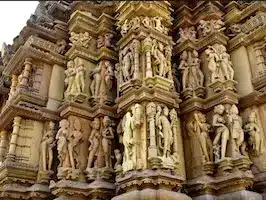
The Path from Exterior to Sanctuary: Erotic scenes are carved exclusively on the outer surface of the temple. The worshipper circumambulates the structure, contemplating the beauty of bodies, desire, and the abundance of material life, before entering the dark, plain inner sanctum (Garbhagriha, the « womb-chamber ») to encounter the deity in silence.
Absence of Rupture: The art of Khajuraho demonstrates that no boundary exists between the carnal and spiritual realms. The beauty of the human body in arousal or ecstasy was carved into stone as an offering to the glory of the divine.
Part 2: Ancient China — Yin, Yang, and the Bedchamber Arts (Fangzhongshu)
“The Way of Yin and Yang is the fundamental principle of Heaven and Earth, the framework of all creation, the origin of life and death, the sanctuary of the gods.”
— Huangdi Neijing (The Yellow Emperor’s Classic of Internal Medicine, c. 3rd century BCE)
1. The Cosmos as Breath: Complementary Polarity
In ancient Chinese thought, elaborated through Taoism and Traditional Chinese Medicine (TCM), the universe is not the product of a single creative decree, but an uninterrupted dynamic process of transformation. It rests on the fluid interaction of two primordial and complementary forces:
Yin (陰): The feminine principle, associated with shade, water, receptivity, earth, the moon, and stillness.
Yang (陽): The masculine principle, associated with light, fire, activity, heaven, the sun, and movement.
Unlike Western dualisms that pit good against evil or spirit against matter, Yin and Yang do not oppose one another: they generate, complete, and nourish each other. Human sexuality (Fangzhongshu, 房中術, literally « The Art of the Bedchamber ») is the foundational practice used to harmonize these two energies within the human body.
2. Subtle Physiology: Jing, Qi, and Shen
In the Taoist tradition, eroticism is intrinsically tied to health preservation, longevity, and the pursuit of spiritual immortality. Sexuality works directly with the « Three Treasures » (San Bao) of existence:
Jing (精): Vital essence, seminal energy in men and menstrual/ovarian energy in women. Jing is a precious, finite capital inherited at birth.
Qi (氣): The vital breath circulating through the body and energy meridians.
Shen (神): Spirit, higher consciousness.
Taoist erotic practice aims to convert Jing into Qi, and subsequently Qi into Shen, through the refinement of physical pleasure.
The Art of Seminal Retention (Coitus Reservatus):
Ancient treatises (such as the Mawangdui Manuscripts or the Ishimpō) taught men to master ejaculation while prolonging intercourse. The goal was not abstinence or frustration, but the accumulation and circulation of energy. Male orgasm without loss of semen allowed Jing to ascend along the spine (the Du Mai meridian) to the brain, rejuvenating physical and mental vitality (Huan Jing Bu Nao).
3. Female Pleasure as an Inexhaustible Source of Energy
A remarkable feature of Taoist bedchamber treatises is the elevated status granted to female pleasure. Unlike male semen, viewed as a finite resource if squandered, a woman’s Yin energy was considered inexhaustible and restorative.
Satisfaction of the Partner: A man could only absorb the beneficial Yin energy if the woman reached full ecstasy. Neglecting female pleasure was categorized in medical texts as a severe fault causing illness and the decline of vitality.
The Nine Signs of Ecstasy: The classic treatise by Sun Simao describes with poetic and clinical precision the stages of female desire and pleasure (breath, salivation, contractions, vocalization), guiding the man to adapt his rhythm and harmonize with his partner.
4. Erotic Literature and Spring Paintings (Chungonghua)
Beyond medicine and the search for longevity, Chinese culture during the Ming and Qing dynasties gave rise to an unprecedented aesthetic and literary refinement.
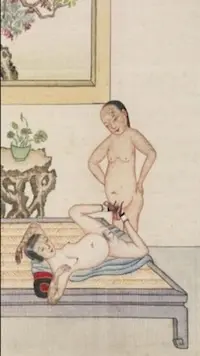
Spring Paintings (Chungonghua): Painted on silk scrolls or albums, these works depicted erotic pleasure set within lush gardens, tea pavilions, and scholarly residences. Far from being viewed as vulgar, these paintings were frequently included in noble bridal dowries, serving as instructional guides and talismans of prosperity for the couple.
The Erotic Novel: Literary masterpieces such as Jin Ping Mei (The Plum in the Golden Vase) or Li Yu’s The Carnal Prayer Mat explored passion, sensuality, and the intricacies of desire with psychological, social, and moral subtlety, framing the carnal dimension as a mirror of the human condition.
5. Absence of Condemnatory Morality
In classical Chinese tradition (prior to the later austerity imposed by certain developments of Neo-Confucianism):
The sexual act was never viewed as a sin, moral fault, or defilement.
It was considered as natural and necessary as eating, drinking, or breathing.
The only « deviation » condemned by traditional medicine was disorderly excess or mindless dissipation—not because it offended a deity, but because it disrupted bodily harmony and shortened life.
Pourquoi aimons-nous lire des histoires érotiques intenses ?
Parce qu'elles permettent de vivre des émotions fortes en toute liberté, loin des règles du quotidien.